The $455M Search for an Endometriosis Diagnosis

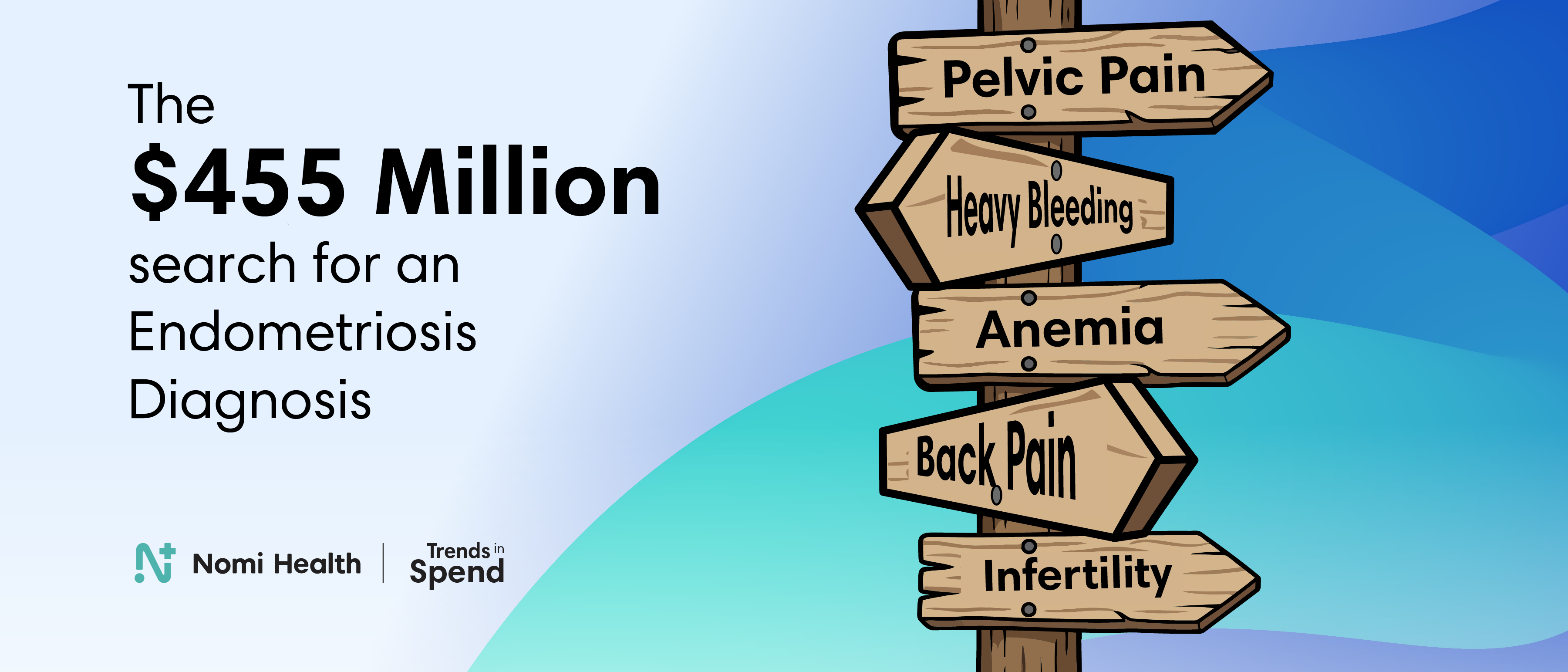
Nomi Health examined claims for selected overlapping symptoms and conditions during the year before endometriosis first appeared in members’ claims histories. A national extrapolation suggests the spending could reach approximately $455 million annually.
For most women with endometriosis, the condition does not begin the day it appears in a medical record. It begins with a period that is not like everyone else’s. With pain that flattens a workday, a school day or an entire weekend, every month, on schedule. Often, it begins with being told that this is simply what having a body like hers feels like.
It can take 4 to 11 years for a woman to receive a correct diagnosis of endometriosis, according to the American Medical Association. Endometriosis can resemble many other conditions and, historically, confirming it often requires surgery. Before taking that step, patients may receive care for pelvic pain, heavy bleeding, bowel and bladder problems, fatigue, low back pain or difficulty getting pregnant; one symptom at a time, without an answer that connects them.

Appointments, prescriptions, and unanswered questions can accumulate for years. An answer may not come until someone steps back and considers the whole picture instead of treating each symptom on its own.
Nomi Health’s clinical team, led by Dr. Rani Aravamudhan, set out to reconstruct that search for women who ultimately reached a diagnosis. The team identified 21,415 women in the Artemis Book of Business with a first observed endometriosis diagnosis in 2023 or 2024 and examined claims associated with 20 overlapping symptoms and conditions* during the final 12 months before diagnosis.
Among those with a first observed endometriosis diagnosis in 2024, 59% had claims associated with overlapping symptoms and conditions during the preceding 12 months.
The symptoms were visible the whole time. The pattern was not.
What the search costs
Across two cohorts of women with a first observed endometriosis diagnosis in 2023 or 2024, Nomi’s analysis identified $37.1 million in allowed medical and pharmacy spending associated with 20 overlapping symptoms and conditions in the 12 months before diagnosis.
Read that number carefully. It does not mean the care was unnecessary, that earlier diagnoses were wrong, or that the money was wasted. It shows how much was spent before endometriosis appeared as a diagnosis.

The analysis captures only part of the search. It includes women who eventually received a diagnosis, but not those still looking for an answer. Claims also leave other costs largely out of view: what women pay out of pocket, hours away from work and family, and the cumulative burden of spending years seeking answers.
To put the finding in a broader context: if the same spending pattern applied to an estimated 250,000 women newly diagnosed nationally each year, it would represent nearly $500M of spend in the year before diagnosis.
Of course, the financial cost is just one small part of the story.
The condition is common. The diagnosis is not.
Start with the national picture. About 1 in 10 women of reproductive age has endometriosis, and as many as 6 out of every 10 cases go undiagnosed — a figure the American Medical Association cites from the American Journal of Obstetrics and Gynecology. Peak prevalence falls between ages 25 and 35, but the condition is most commonly diagnosed in a woman's 30s and 40s. Put plainly: the diagnosis tends to arrive a decade after the disease does.
Before an established diagnosis, care for overlapping symptoms and conditions may be dispersed across claims categories. That can make the broader pattern harder to recognize in condition-level reporting and incorporate into benefits planning.
The $37.1 million captures only a portion of the pre-diagnosis experience. It is limited to 20 selected code families, a 12-month window and women whose endometriosis diagnosis eventually appeared in the data. It excludes women who remained undiagnosed and costs outside the claims included in the analysis.
“What stood out was that these women were actively engaging with their providers and seeking care. This information is fragmented across multiple conditions, providers and sites of care. The opportunity here is to connect those dots earlier, before years of suffering accumulate into a recognizable pattern.” — Dr. Rani Aravamudhan, Senior Medical Director, Nomi Health
Getting the diagnosis doesnt need to be this difficult
Endometriosis can disrupt health, work, and daily life years before pregnancy enters the picture and maybe a reason for infertility.
Claims data at a population level can reveal symptoms and spending scattered across categories instead of being part of a standard care protocol.
Part of the reason for the delay in diagnosis has been attributed to existing diagnostic protocols which base a definitive diagnosis only on a laparoscopic surgery and biopsy; which leads to providers exhausting all other possibilities before they undertake this procedure. This is now beginning to change. New guidance from the American College of Obstetricians and Gynecologists aims to shorten the path to diagnosis by recognizing clinical, and imaging evidence earlier with surgical approaches for more difficult as part of evaluation. The National Institutes of Health is investing in noninvasive diagnostic technologies; saliva-based testing is beginning to emerge internationally, though it is not yet cleared for use in the United States.
This movement creates an important question for employers and health plans: are benefits, networks and authorization policies prepared for earlier recognition, which could increase documented diagnoses and make more endometriosis-related spending visible? In the Artemis Book of Business, members with at least one endometriosis episode of care incurred an average spend per member of $5,455 in 2024 and $5,896 in 2025.
With appropriate clinical oversight, health plans and navigation partners can use population-level data patterns to assess whether members have access to appropriate support and care when they need it most. Employers can examine the parts of the experience they can influence i.e. referral requirements, prior authorizations, specialist access, network design and cost-sharing that may add friction to an already long search.
Investing earlier means building benefits, navigation, and reporting systems that can recognize fragmentation and adapt as new diagnostic pathways become available.
Women may still have to make the search. They shouldn’t have to build the path as they go.
--------
¹ The American Medical Association cites a diagnostic delay of approximately four to 11 years for endometriosis.
*Nomi Health examined primary medical claims associated with 20 selected ICD-10-CM codes in the Artemis Book of Business during the 12 months before a first observed endometriosis diagnosis. These included pelvic and lower abdominal pain, other pain diagnoses, sciatica and low back pain, urinary tract infection, pelvic inflammatory disease, abnormal menstruation, gynecologic and menstrual pain, infertility, uterine fibroids, iron deficiency anemia, polycystic ovarian syndrome, irritable bowel syndrome, diverticular disease, ulcerative colitis and indeterminate colitis.
Terminology
a. First Observed Diagnosis – The date when presence of ICD-10 Diagnosis code N80* (in any position) on medical claims is observed for the 1st time for a member in a given year. From this initial group, only those who had been enrolled for at least 36 months prior to the date of diagnosis were selected for the cohorts.
b. Age range: female members 13 and above
c. All costs refenced in the article are all Allowed amounts; they include both plan paid and member paid $$
d. Cost of care PRIOR to a first observed diagnosis – based on Primary Diagnosis only for the conditions listed above (to ensure that cost of direct treatment for those conditions only are included). This cost does NOT include claim/s with the 1st observed diagnosis of endometriosis.