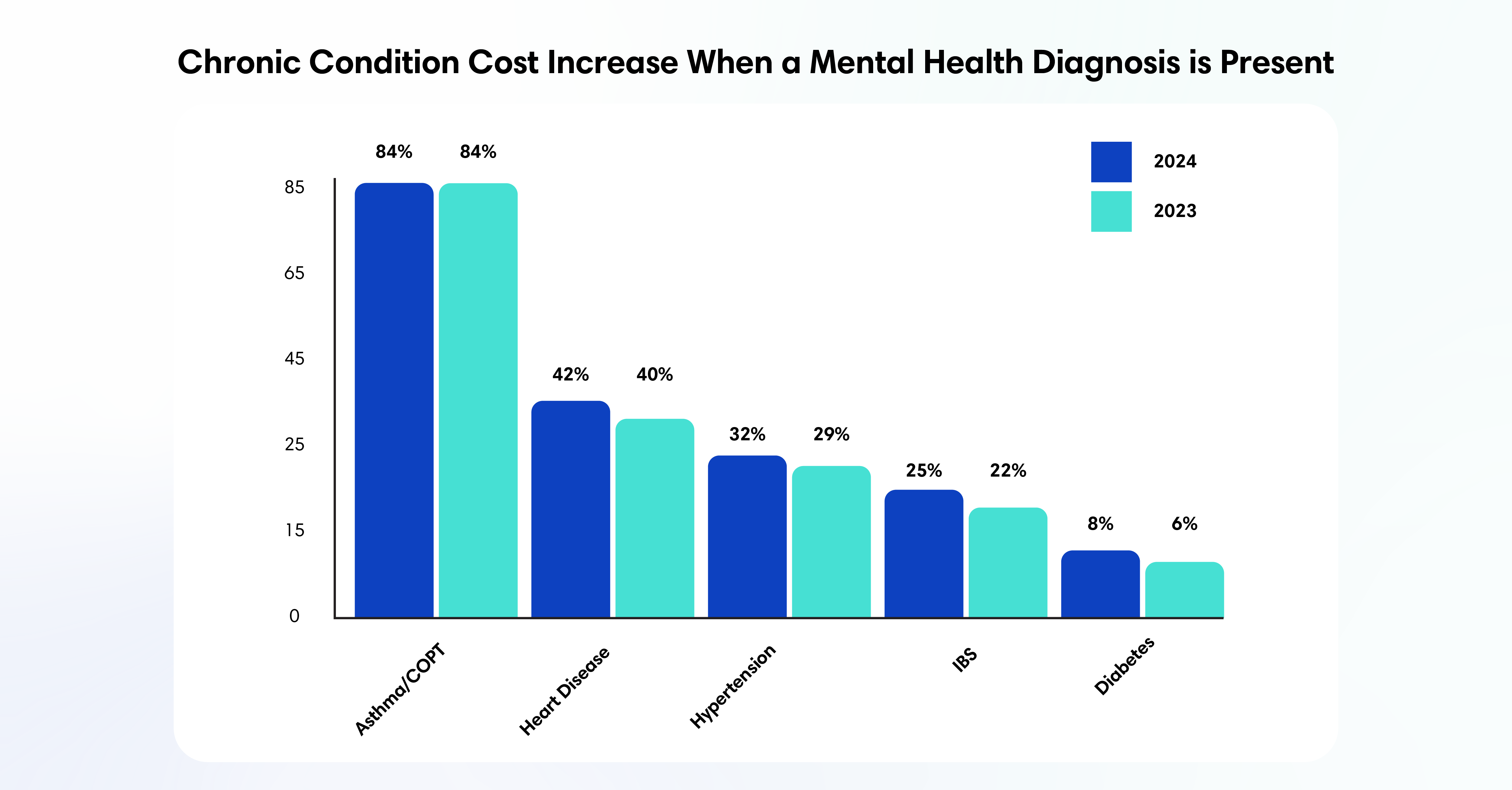
New analysis from Nomi Health finds that mental health comorbidities raise the cost of treating chronic conditions by 6% to 84%, depending on the condition, a range that carries significant implications for self-funded employer health plans.
A mental health diagnosis raises the cost of treating asthma and COPD by 84%. That number held steady across two years and 230,000 members. Among five major chronic conditions, including diabetes, hypertension, IBS, and heart disease, nothing else comes close.
Asthma and COPD sit at the extreme end of a range that turns out to be surprisingly wide. A mental health diagnosis raises the cost of treating a chronic condition, but how much depends heavily on which condition. Across five major chronic conditions, the range spans 6% to 84%.
Nomi Health analyzed 2023 and 2024 claims data from self-funded employers, splitting members with a chronic condition into two groups: those without a mental health comorbidity and those with one. We then measured what it costs to treat the chronic condition itself (excluding the cost of the mental health condition) across both groups, for each condition separately.
Diabetes sits at the low end, with a modest differential that compressed slightly between years. Asthma and COPD sit at the top, at 84% in both years, with no movement at all.
Asthma and COPD Carry the Highest Cost Burden
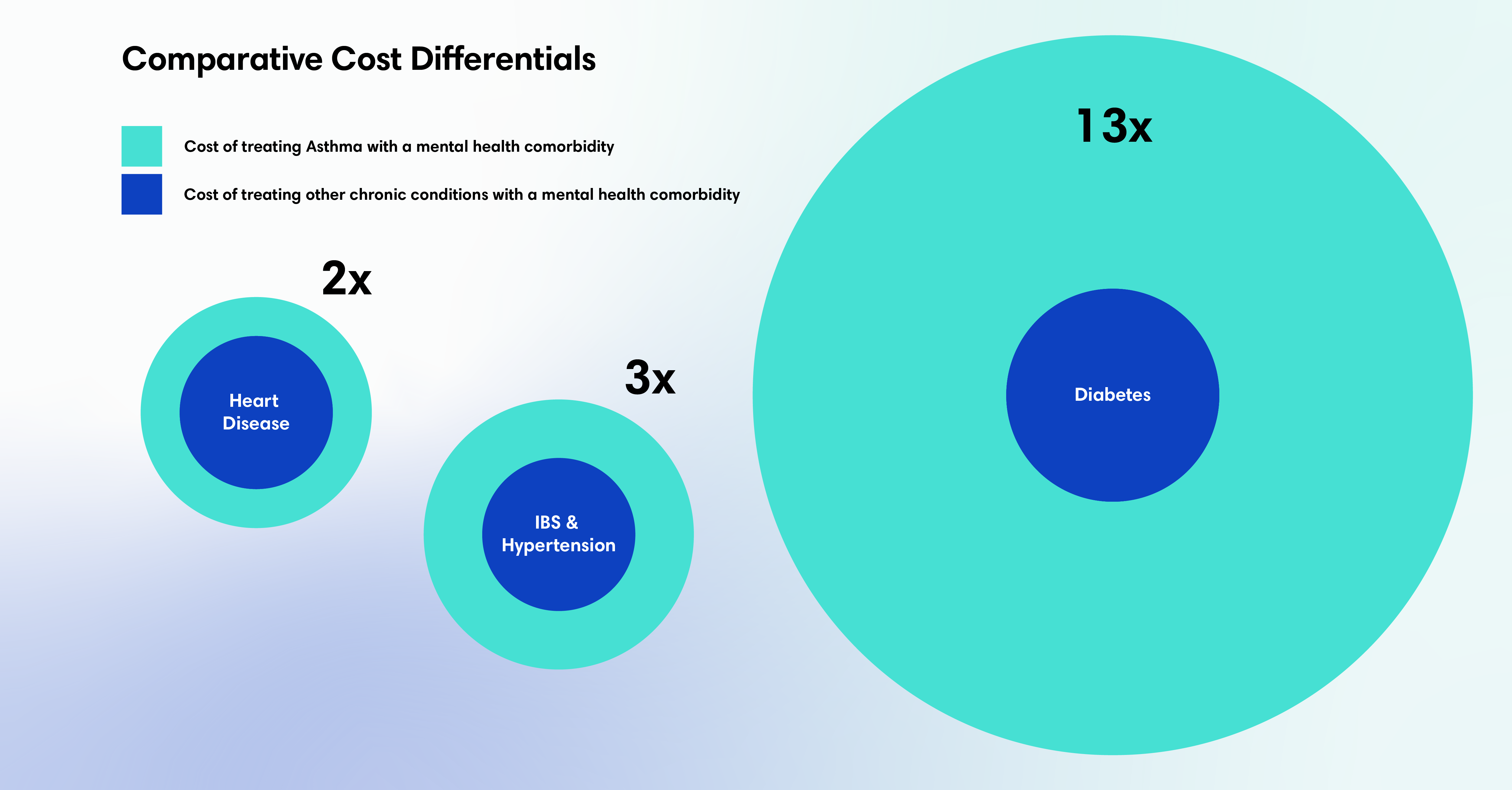
The 84% differential for asthma and COPD is nearly double the differential for ischemic heart disease, triple that of inflammatory bowel disease, and thirteen times that of diabetes. Members managing asthma or COPD alongside a mental health diagnosis cost 84% more to treat for that respiratory condition than members managing it alone, and that number didn't budge between 2023 and 2024.
Across the 230k+ members in this analysis with asthma and COPD and a mental health diagnosis, that differential is a substantial cost driver. And for employers covering younger dependents, it carries additional weight. Asthma is one of the most prevalent chronic conditions in children and adolescents, and Gen Alpha members in this dataset show some of the highest comorbidity cost differentials of any age group, largely because their chronic condition burden is dominated by asthma. Most haven't yet developed diabetes, hypertension, or heart disease. For Gen Alpha, asthma is the cost story.
Diabetes Shows the Lowest Mental Health Comorbidity Cost Differential.
At 6-8%, diabetes carries the lowest differential in the dataset by a significant margin. Around 200,000 members per year in this analysis carry both diabetes and a mental health comorbidity. For the most common chronic condition in the dataset, a relatively small cost differential still warrants attention.
Hypertension: The Largest Comorbidity Cost Exposure for Self-Funded Employers
Hypertension sits at 22-25%, a mid-range differential. But it carries the largest affected population by far: over 500,000 members with both a chronic condition alongside a mental health diagnosis in both years. At that scale, a moderate differential generates significant absolute cost. For most self-funded employers, hypertension is likely where the largest dollar exposure sits, even if asthma and COPD carries the more dramatic differential. At that population scale, a 22-25% cost increase adds up fast.
Why Do Mental Health Comorbidities Raise Chronic Condition Costs?
The data doesn't explain why these differentials vary so widely. But the pattern held across two years and millions of members, which suggests something real is driving it.
How Self-Funded Employers Can Act on Mental Health Comorbidity Data
The aggregate mental health comorbidity finding, an 18-19% average cost differential, appears in trend reports. The condition-level breakdown typically doesn't. For self-funded employers, a few questions are worth asking now:
Where does a mental health diagnosis drive up your chronic condition costs most?
The spread in this data suggests the answer varies significantly by population. A population with frequent overlap between asthma and mental health diagnoses faces a very different cost picture than one where hypertension and mental health diagnoses co-occur most. Start by running a condition-level breakdown of your claims data to see where those combinations concentrate in your population.
How are your chronic condition programs handling mental health?
For conditions where the two are managed separately, our data suggests that the separation has a cost. Map your current chronic condition vendors against your mental health vendors to identify where those programs operate independently and where they connect.
Are your Gen Alpha dependents flagged?
Asthma prevalence is high in younger populations, the comorbidity differential is large, and the cost impact compounds over time. Pull your dependent claims now to identify asthma members who also carry a mental health diagnosis; that population is visible in your data today.
How Mental Health Comorbidity Costs Vary by Generation
The conditions with the highest differentials and the generations with the highest differentials aren't independent questions. To see how the comorbidity cost gap plays out across generations, and why Millennials and Gen Z tell a very different story than Boomers and Gen X, read our previous analysis.
Subscribe to Nomi's Trends in Spend
Get the latest spending trends and analysis delivered to your inbox.
{ "@context": "https://schema.org", "@type": "Article", "headline": "A Mental Health Diagnosis Raises the Cost of Treating Asthma and COPD by 84%", "description": "Nomi Health analyzed 2023-2024 claims data from 230,000+ members across five chronic conditions and found that mental health comorbidities raise treatment costs by 6% to 84% - with asthma and COPD at the extreme high end and diabetes at the low end. Here is what the condition-level breakdown means for self-funded employers.", "image": "https://cdn.prod.website-files.com/655c259f56587d6f1221618b/6a078779044526057ae048fb_Comorbidity-Asthma-Cover.png", "author": { "@type": "Person", "name": "Dr. Rani Aravamudhan", "url": "https://www.linkedin.com/in/rani-aravamudhan/" }, "publisher": { "@type": "Organization", "name": "Nomi Health", "url": "https://www.nomihealth.com" }, "datePublished": "2026-04-30T00:00:00+00:00", "dateModified": "2026-04-30T00:00:00+00:00", "url": "https://www.nomihealth.com/trends-in-spend/a-mental-health-diagnosis-raises-the-cost-of-treating-asthma-and-copd-by-84", "about": [ { "@type": "Thing", "name": "mental health comorbidities" }, { "@type": "Thing", "name": "chronic condition costs" }, { "@type": "Thing", "name": "self-funded employer health plans" }, { "@type": "Thing", "name": "asthma and COPD cost burden" }, { "@type": "Thing", "name": "behavioral health integration" } ], "isBasedOn": { "@type": "Dataset", "name": "Nomi Health Mental Health Comorbidity Cost Analysis, 2023-2024", "description": "2023 and 2024 medical claims data from self-funded employers, covering 230,000+ members with chronic conditions, analyzed for cost differentials between members with and without mental health comorbidities across five major chronic conditions: asthma and COPD, diabetes, hypertension, ischemic heart disease, and inflammatory bowel disease.", "creator": { "@type": "Organization", "name": "Artemis, a Nomi Health company" } } }
{ "@context": "https://schema.org", "@type": "FAQPage", "mainEntity": [ { "@type": "Question", "name": "How much does a mental health diagnosis increase the cost of treating asthma and COPD?", "acceptedAnswer": { "@type": "Answer", "text": "A mental health diagnosis raises the cost of treating asthma and COPD by 84%, based on Nomi Health's analysis of 2023 and 2024 claims data from 230,000+ members. That differential held steady across both years with no movement, making asthma and COPD the highest mental health comorbidity cost burden among the five major chronic conditions analyzed - nearly double the differential for ischemic heart disease and thirteen times that of diabetes." } }, { "@type": "Question", "name": "What is the average cost increase from mental health comorbidities across chronic conditions?", "acceptedAnswer": { "@type": "Answer", "text": "Across five major chronic conditions, Nomi Health's analysis found an average mental health comorbidity cost differential of 18-19%. That aggregate figure appears in many trend reports, but the condition-level range - 6% for diabetes to 84% for asthma and COPD - tells a more actionable story for self-funded employers trying to target intervention." } }, { "@type": "Question", "name": "Which chronic condition has the lowest mental health comorbidity cost differential?", "acceptedAnswer": { "@type": "Answer", "text": "Diabetes has the lowest mental health comorbidity cost differential of the five conditions analyzed, at 6-8% across 2023 and 2024. Around 200,000 members per year in Nomi Health's analysis carried both diabetes and a mental health comorbidity. Diabetes also has one of the longest histories of whole-patient care management in employer health plans - a pattern that may be relevant to its relatively contained differential." } }, { "@type": "Question", "name": "Where does mental health comorbidity create the largest total cost exposure for self-funded employers?", "acceptedAnswer": { "@type": "Answer", "text": "Hypertension creates the largest total cost exposure for most self-funded employers. Its 22-25% cost differential is mid-range, but hypertension carries the largest affected population - over 500,000 members with both a chronic condition and a mental health diagnosis in each year analyzed. At that scale, a moderate differential generates significant absolute dollar cost." } }, { "@type": "Question", "name": "Why do mental health comorbidities raise chronic condition treatment costs?", "acceptedAnswer": { "@type": "Answer", "text": "Nomi Health's data does not confirm causation, but a notable pattern emerges: diabetes, which has the longest history of integrated whole-patient care management coordinating physical and mental health, carries the lowest comorbidity cost differential at 6-8%. Asthma and COPD, at 84%, have largely been managed as physical conditions in isolation. The data suggests that separating chronic condition and mental health programs may carry a measurable cost." } }, { "@type": "Question", "name": "How does asthma and mental health comorbidity affect Gen Alpha dependent costs?", "acceptedAnswer": { "@type": "Answer", "text": "Gen Alpha members show some of the highest comorbidity cost differentials of any age group, largely because their chronic condition burden is dominated by asthma - the condition with the highest mental health comorbidity cost differential at 84%. Most Gen Alpha dependents have not yet developed diabetes, hypertension, or heart disease. For employers covering younger dependents, asthma is the primary comorbidity cost story, and that impact compounds over time." } }, { "@type": "Question", "name": "How should self-funded employers identify where mental health comorbidities are driving chronic condition costs?", "acceptedAnswer": { "@type": "Answer", "text": "Employers should run a condition-level breakdown of their claims data to see where chronic condition and mental health diagnoses concentrate together - the range in Nomi Health's data, from 6% for diabetes to 84% for asthma and COPD, means the answer varies significantly by population. Mapping current chronic condition vendors against mental health vendors can identify where those programs operate independently and where they connect. For employers covering dependents, pulling asthma claims for members who also carry a mental health diagnosis is a practical starting point." } } ] }
[ { "@context": "https://schema.org", "@type": "ScholarlyArticle", "name": "The Evolution of Diabetes Treatment Through the Ages: From Starvation Diets to Insulin, Incretins, SGLT2-Inhibitors and Beyond", "url": "https://pmc.ncbi.nlm.nih.gov/articles/PMC9942084/", "description": "A peer-reviewed history of diabetes treatment cited in support of Nomi Health's observation that diabetes has the longest track record of integrated whole-patient care management among major chronic conditions." }, { "@context": "https://schema.org", "@type": "ScholarlyArticle", "name": "COPD and Comorbid Mental Health: Addressing Anxiety, Depression, and Their Clinical Management", "url": "https://www.mdpi.com/1648-9144/61/8/1426", "description": "A 2025 narrative review published in Medicina examining the prevalence, mechanisms, and clinical management of anxiety and depression as comorbidities in COPD patients, cited in support of Nomi Health's findings on mental health comorbidity cost differentials." } ]