Mental Health Comorbidities Drive Up Chronic Disease Costs by 18%. Millennials and Gen Z Didn't Get the Memo.

A mental health diagnosis adds 18% to the cost of treating a chronic condition. Except when it doesn't.
Nomi Health analyzed 2023 and 2024 claims data from self-funded employers, splitting members with a chronic condition into two groups: those without an additional mental health diagnosis (a comorbidity) and those with one. We measured what it costs to treat the chronic condition itself (not the mental health care) across both groups, spanning 2+ million members across every adult generation.
Millennials carry the highest mental health comorbidity rate of any generation in this dataset. By every conventional expectation, their chronic disease costs should reflect that. Instead, their cost differential between members with and without a mental health comorbidity is nearly zero: just 3-4% across both years.
Gen Z goes further. Their members with a mental health comorbidity spend slightly less on chronic condition care than those without one.
Mental Health Comorbidity Costs by Generation
Across the book of business, the baseline finding is unambiguous: members with a comorbid mental health diagnosis see higher treatment costs for their chronic condition, independent of the mental health care itself. That 18-19% cost increase held steady across both years. But the generational breakdown tells a more complicated story.
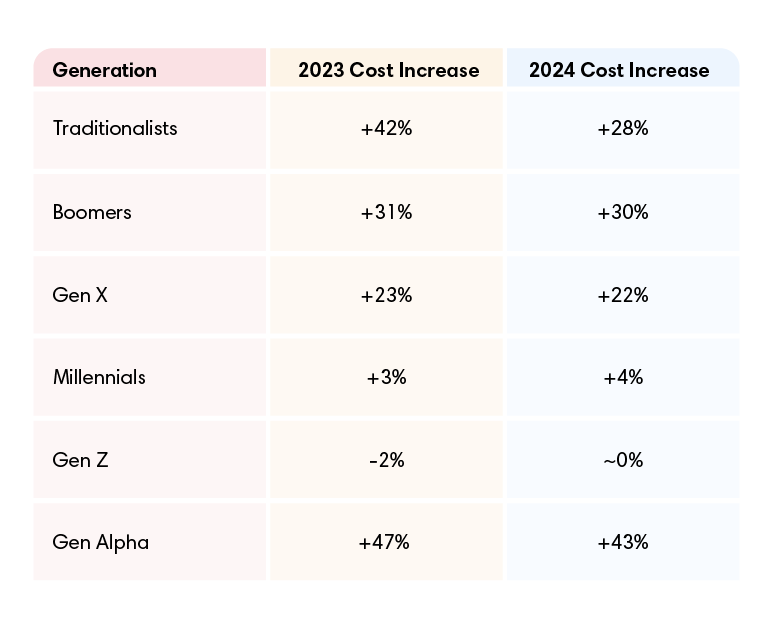
* Gen Alpha's chronic condition burden looks fundamentally different from adult generations — driven almost exclusively by asthma — and warrants its own case study. Stay tuned for part 2.
Older generations follow the expected pattern, and then some. Traditionalists carrying both a chronic condition and a mental health diagnosis cost 42% more to treat in 2023. Boomers and Gen X show a persistent 22-31% premium across both years. These are large populations: Boomers contributed over 400,000 members annually, Gen X nearly 600,000. The cost difference is real, it's stable, and it's expensive.
Then the pattern collapses. Millennials, despite representing the highest comorbidity rate of any generation, show a differential that rounds to zero. Gen Z members with a mental health diagnosis actually cost slightly less to treat than those without one, the only generation where that's true.
Why Millennials and Gen Z Show a Near-Zero Mental Health Comorbidity Cost Differential
The mechanism behind the generational gap isn't confirmed by this data alone, but the pattern points in a clear direction.
Millennials and Gen Z have fundamentally different relationships with mental health care than older generations. They're more likely to seek treatment, more likely to stay in treatment, and more likely to treat mental health as a routine part of managing their overall health. For these generations, a mental health diagnosis is more likely to mean active, ongoing care, not a condition left unaddressed.
The hypothesis this data supports: managed mental health doesn't compound chronic disease costs the way unmanaged mental health does. The 18-19% premium visible in older generations may not be an inevitable feature of having both conditions. It may be a feature of treating them in silos or not treating one of them at all.
That reframes the ROI on mental health benefits entirely. An employer investing in mental health access isn't just supporting workforce wellbeing. For members already managing a chronic condition, it may be one of the most direct levers available to control chronic disease cost trends.
What Mental Health Comorbidity Data Means for Self-Funded Employers
Most benefits architectures treat physical and mental health as separate tracks: different vendors, different utilization management, different budget lines. This data puts a price on that separation.
For self-funded employers, a few questions are worth asking now:
Who are your members managing a mental health condition alongside a chronic condition? You can identify members managing a chronic condition alongside a mental health diagnosis in claims data today. Gen X contributed nearly 300,000 such members annually in this analysis. Boomers exceeded 175,000. These are a large, predictable, high-cost population already inside your plan.
How are you crediting mental health benefits? Most plans measure mental health ROI in isolation. Our analysis suggests that's incomplete. For members already managing a chronic condition, access to mental health care may be compressing an 18-19% cost premium on that condition. That value is real whether or not anyone is tracking it. Most employers aren't.
Are your vendors designed to work together? The Millennial and Gen Z data suggests that mental health support embedded within chronic disease management rather than routed around it suppresses the cost premium in younger cohorts. The question for employers is whether their current program architecture makes that support possible.
Will Millennials' Low Comorbidity Premium Hold as Chronic Disease Rates Rise?
Millennials' chronic disease burden is still relatively low. Diabetes affects just 3% of Millennials in this dataset, compared to 17% of Boomers. Hypertension sits at 7%, versus 42% for Boomers. As those numbers grow over the next decade, the critical question is whether Millennials maintain their near-zero differential because mental health engagement continues to suppress the premium, or whether the gap widens as conditions become more severe.
That question is worth watching closely. The answer will tell employers a great deal about whether integrated mental health care is genuinely bending the chronic disease cost curve, or whether Millennials simply haven't gotten sick enough yet.
The data so far suggests that mental health engagement closes the cost gap. And the cost of betting wrong is already visible in your claims.
Want to see how the comorbidity premium shows up in your specific population? Nomi Health can run this analysis against your plan data to identify your high-cost comorbid members and model the opportunity.
Frequently Asked Questions
Does having a mental health diagnosis increase chronic disease treatment costs?
Yes. Across Nomi Health's analysis of 2023 and 2024 claims data from self-funded employers, members with a chronic condition and a comorbid mental health diagnosis cost 18–19% more to treat for their chronic condition than members managing the chronic condition alone. That differential excludes the cost of mental health care itself.
Why do Millennials and Gen Z show lower comorbidity cost differentials?
Millennials show a near-zero differential (3–4%), and Gen Z members with a mental health diagnosis actually cost slightly less to treat for their chronic condition than those without one. Studies suggest that these generations are more likely to seek and sustain mental health treatment, and that managed mental health may not compound chronic disease costs the way unmanaged mental health does.
Does treating mental health reduce chronic disease costs?
This analysis can't confirm causation, but the pattern across two years and 2+ million members is consistent: the generations with the highest rates of mental health treatment engagement show the lowest comorbidity cost premium on chronic conditions. For self-funded employers, that relationship has real implications for how mental health benefits are valued.
How can self-funded employers identify members with mental health and chronic disease comorbidities?
This population is visible in claims data today. In Nomi Health's analysis, Gen X contributed nearly 300,000 members annually managing both a chronic condition and a mental health diagnosis. Boomers exceeded 175,000. A condition-level comorbidity breakdown of your own plan data can identify where your highest-cost combinations concentrate.
What does "comorbidity" mean in healthcare claims data?
In this context, a comorbidity refers to a member carrying two simultaneous diagnoses — here, a chronic physical condition (such as diabetes, hypertension, or asthma) alongside a mental health diagnosis. The comorbidity cost differential measures how much more it costs to treat the chronic condition when a mental health diagnosis is also present, independent of any mental health care costs.