Specialty drugs have transformed pharmaceutical spending over the past decade; some of these medications cost hundreds of thousands of dollars annually. In 2023, the FDA began approving biosimilars for adalimumab (Humira), one of the world's best-selling drugs. Unlike traditional generics, biosimilars are highly similar but not identical copies of biologics, offering the potential for significant cost savings while maintaining clinical effectiveness.
Humira biosimilars launched with 80-85% discounts and FDA approval for automatic pharmacy substitution. We wanted to know: did those savings actually reach employers?The answer: not always.
We analyzed 2024 prescription data from more than 950 self-funded employers. Our data reveals significant cost variations. For self-funded employers, knowing which biosimilar their plan offers can mean thousands of dollars per prescription in savings or losses.
Humira Biosimilar Cost Comparison: What 950+ Employers Actually Paid in 2024
1. Prices for different biosimilars vary by more than 4x: The same class of medications ranges from $639 (Yusimry) to $2,655 (Amjevita) per prescription across our book of business, a $2,016 difference.
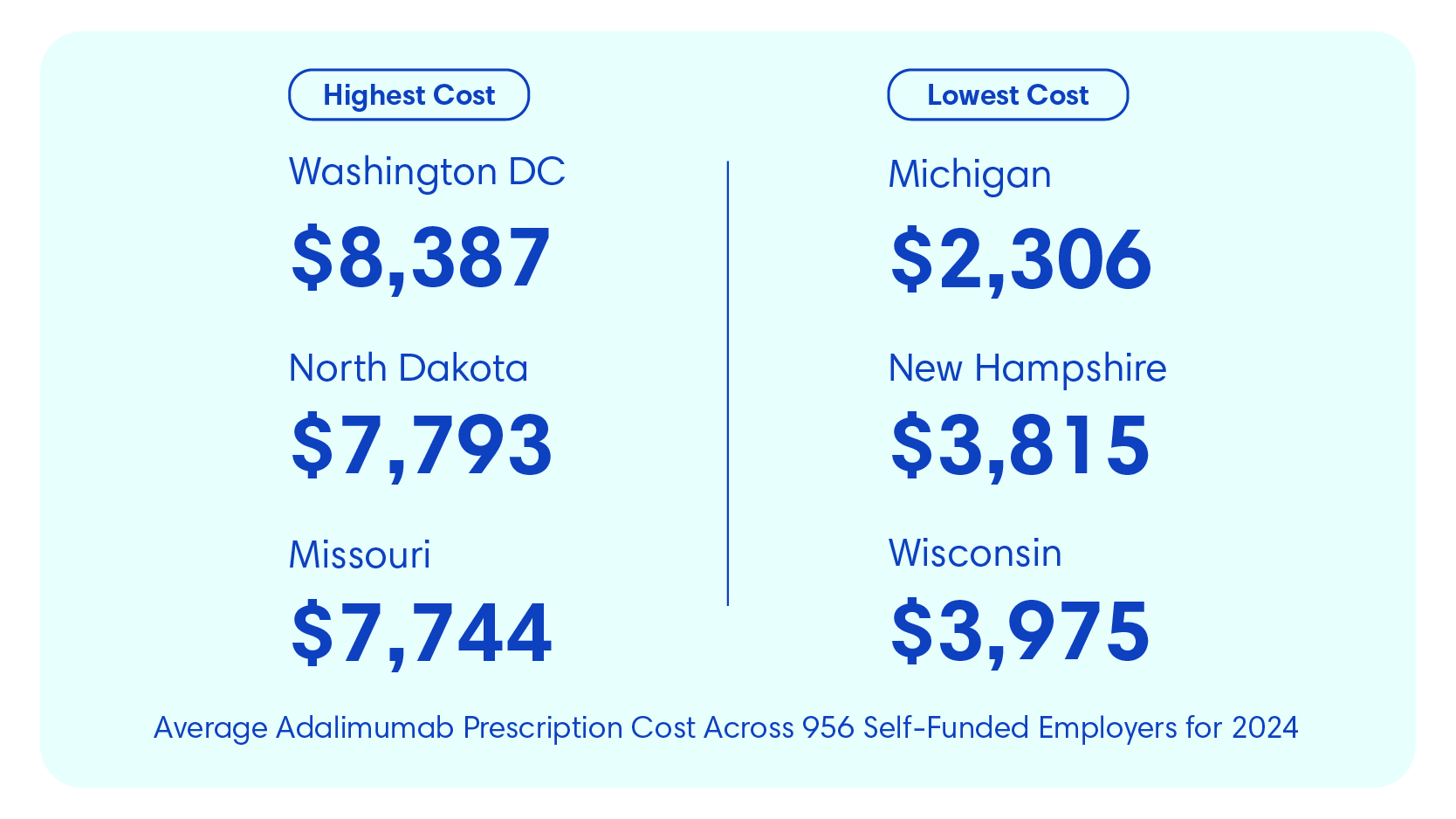
2. Costs differ dramatically across states: The weighted average cost for adalimumab prescriptions varies from $8,387 in Washington DC (highest) to $2,306 in Michigan (lowest), a $6K gap between our clients in these states.
3. High capture rates don't guarantee low costs: For our clients in Vermont, biosimilar prescriptions grew by more than double Humira's decline (226% capture rate). Yet Vermont's average cost remains high at $6,182 per script, while Michigan achieves both strong capture (76%) and low costs ($2,317).
Yusimry vs. Amjevita vs. Hyrimoz vs. Hadlima: A Full Biosimilar Price Comparison
Not all biosimilars cost the same. The average price per script across our client data reveals a wide range of price points:
Yusimry: $639 per script (91% less than Humira)
Hadlima: $929 per script (86% less than Humira)
Hyrimoz: $1,455 per script (79% less than Humira)
Amjevita: $2,655 per script (55% less than Humira
The price differential between the lowest and highest cost biosimilars reaches $2,016 per prescription.
Why High Biosimilar Adoption Doesn't Guarantee Lower Costs
According to our employer data, biosimilar capture rates vary significantly across our book of business, from 34% capture in Arkansas to 226% in Vermont; but our data shows that capture rates don't predict costs. In 2024:
Arkansas: For every 100 Humira prescriptions lost, only 34 biosimilar prescriptions appeared (34% capture rate)
Michigan: For every 100 Humira prescriptions lost, 76 biosimilar prescriptions appeared (76% capture rate)
Vermont: 226 biosimilar prescriptions appeared for every 100 Humira prescriptions lost (226% capture rate - which indicates that some new patients started directly on biosimilars)
However, more biosimilar prescriptions don't automatically mean lower costs. Our clients in Vermont show high biosimilar market capture with a weighted average price of $6,182 per script, while Michigan achieves both high capture and lower costs at $2,317 per script.
Why Employers Can't See What They're Really Paying for Biosimilars
These wide variations raise an important question: Do employers know what they're paying for biosimilars? The range in our data supports the idea that employers may face limited visibility into which specific biosimilars their plans utilize. Employers might see reports showing "biosimilar adoption" but can't tell if they're paying $639 or $2,655 per prescription without digging into detailed claims data. Even employers with pricing transparency still face rebate opacity; they can see what they paid, but not the manufacturer rebate, or why certain biosimilars made the formulary while cheaper options didn't.
Three Questions Every Employer Should Ask About Their Biosimilar Formulary
The $6,081 per-prescription gap between employers in our highest-cost state (DC) and lowest-cost state (Michigan) represents significant potential savings...or losses. Based on these findings, employers should ask:
1. Is Yusimry on your formulary? At $639 per script, it costs 76% less than Amjevita ($2,655).
2. What's your weighted average adalimumab cost? Our data shows employer averages ranging from $2,306 to $8,387.
3. Does your plan design support lowest-cost options? Copay structures, formulary tiers, and employee awareness all influence whether your plan captures the best biosimilar pricing.
With dozens of biosimilars for other specialty drugs entering the market in 2025-2026, these patterns may preview broader challenges ahead.
Methodology Note: This analysis examines prescription data from 956 self-funded employers, analyzing adalimumab (Humira and biosimilar) utilization patterns and costs in 2024. The data represents actual prescription costs before manufacturer rebates.
This analysis is part of Nomi Health's Trends in Spend series, examining healthcare spending patterns through employer claims data. Subscribe for monthly data analysis. Follow on LinkedIn for ongoing updates.
Frequently Asked Questions
What is the cost difference between Humira biosimilars?
Based on 2024 prescription data from more than 950 self-funded employers, adalimumab biosimilar costs range from $639 per prescription (Yusimry) to $2,655 per prescription (Amjevita), a difference of more than $2,000 per script depending on which biosimilar your plan formulary uses.
How does Hyrimoz compare to Humira in cost?
In our 2024 employer claims data, Hyrimoz averaged $1,455 per prescription, approximately 79% less than brand-name Humira.
How does Hadlima compare to Humira in cost?
Hadlima averaged $929 per prescription in our 2024 employer data, approximately 86% less than brand-name Humira.
Does switching to biosimilars guarantee lower costs for employers?
Not automatically. Our data shows that high biosimilar adoption rates don't always correlate with lower costs. Employers in Vermont had a 226% biosimilar capture rate but a weighted average cost of $6,182 per script, while Michigan achieved both strong adoption and lower costs at $2,317 per script. Formulary design and pricing transparency matter as much as adoption.
What should employers ask about their biosimilar formulary?
Three key questions: Is Yusimry on your formulary? What is your plan's weighted average adalimumab cost? Does your plan design support lowest-cost biosimilar options through copay structures and formulary tiers?
Subscribe to Nomi's Trends in Spend
Get the latest spending trends and analysis delivered to your inbox.
{ "@context": "https://schema.org", "@type": "Article", "headline": "Humira Biosimilars Range from $639 to $2,655 Per Prescription. Here's What Self-Funded Employers Are Actually Paying", "description": "Nomi Health analysis of 2024 prescription data from 956 self-funded employers reveals a 4x price gap between Humira biosimilars, dramatic cost variation by state, and a transparency problem: high biosimilar adoption rates do not guarantee lower costs.", "image": "https://cdn.prod.website-files.com/655c259f56587d6f1221618b/6914e65eb142c6178e5a23af_Blog_TIS-Humira-Header%201800x771.png", "author": { "@type": "Person", "name": "Dr. Rani Aravamudhan", "url": "https://www.linkedin.com/in/rani-aravamudhan/" }, "publisher": { "@type": "Organization", "name": "Nomi Health", "url": "https://www.nomihealth.com" }, "datePublished": "2025-11-12T13:00:00+00:00", "dateModified": "2026-05-04T13:00:00+00:00", "url": "https://www.nomihealth.com/trends-in-spend/same-drug-class-4x-the-price-biosimilar-costs-all-over-the-map", "about": [ { "@type": "Thing", "name": "Humira Biosimilars" }, { "@type": "Thing", "name": "Specialty Drug Pricing" }, { "@type": "Thing", "name": "Pharmacy Benefit Management" }, { "@type": "Thing", "name": "Self-Funded Employer Health Plans" }, { "@type": "Thing", "name": "Prescription Drug Transparency" } ], "isBasedOn": { "@type": "Dataset", "name": "Artemis Employer Claims Analysis: Adalimumab Biosimilar Utilization and Costs 2024", "description": "Prescription data from 956 self-funded employers analyzing adalimumab (Humira and biosimilar) utilization patterns, biosimilar capture rates, and actual cost per prescription across states in 2024. Data represents actual prescription costs before manufacturer rebates.", "creator": { "@type": "Organization", "name": "Artemis, a Nomi Health company" } } }
{ "@context": "https://schema.org", "@type": "FAQPage", "mainEntity": [ { "@type": "Question", "name": "How much do Humira biosimilars cost per prescription for self-funded employers?", "acceptedAnswer": { "@type": "Answer", "text": "Humira biosimilar costs vary dramatically depending on which specific biosimilar is on your formulary. Nomi Health analysis of 956 self-funded employers found prices ranging from $639 per prescription for Yusimry to $2,655 for Amjevita - a $2,016 difference for medications in the same drug class. The average weighted cost across states ranges even further, from $2,306 in Michigan to $8,387 in Washington DC." } }, { "@type": "Question", "name": "How does Hyrimoz compare to Humira in cost?", "acceptedAnswer": { "@type": "Answer", "text": "Based on 2024 prescription data from 956 self-funded employers, Hyrimoz averaged $1,455 per prescription — approximately 79% less than brand-name Humira. Among the adalimumab biosimilars in Nomi Health's employer claims data, Hyrimoz falls in the mid-range, costing more than Yusimry ($639) and Hadlima ($929) but less than Amjevita ($2,655)." } }, { "@type": "Question", "name": "How does Hadlima compare to Humira in cost?", "acceptedAnswer": { "@type": "Answer", "text": "In Nomi Health's 2024 employer claims data, Hadlima averaged $929 per prescription — approximately 86% less than brand-name Humira. Hadlima is the second lowest-cost adalimumab biosimilar in our data, behind Yusimry at $639 per prescription." } }, { "@type": "Question", "name": "Why do biosimilar costs vary so much by state?", "acceptedAnswer": { "@type": "Answer", "text": "State-level variation in biosimilar costs reflects differences in which specific biosimilars are on formulary, regional PBM contracting, and local market dynamics. Nomi Health data shows a $6,000 per-prescription gap between the highest-cost state (Washington DC at $8,387 average) and the lowest (Michigan at $2,306). Michigan achieves both strong biosimilar capture rates and low costs - demonstrating that the right formulary strategy, not just adoption volume, drives savings." } }, { "@type": "Question", "name": "Does high biosimilar adoption mean lower costs for employers?", "acceptedAnswer": { "@type": "Answer", "text": "No - and this is one of the most important findings in the Nomi Health analysis. Biosimilar capture rates range from 34% in Arkansas to 226% in Vermont, but higher adoption does not predict lower costs. Vermont has the highest biosimilar capture rate yet maintains an average cost of $6,182 per script. Michigan has a 76% capture rate and achieves $2,317 per script. Which biosimilar is on formulary matters far more than how many biosimilars are dispensed." } }, { "@type": "Question", "name": "Is Yusimry the cheapest Humira biosimilar available to employers?", "acceptedAnswer": { "@type": "Answer", "text": "Based on Nomi Health 2024 claims data across 956 self-funded employers, Yusimry is the lowest-cost biosimilar at $639 per prescription - 91% less than Humira's reference price. Hadlima follows at $929 per script (86% less), Hyrimoz at $1,455 (79% less), and Amjevita at $2,655 (55% less). Employers should verify whether Yusimry appears on their formulary, as it costs 76% less than the highest-priced biosimilar alternative." } }, { "@type": "Question", "name": "Why don't employers know which biosimilar their plan is using?", "acceptedAnswer": { "@type": "Answer", "text": "Most employer biosimilar reports show adoption rates but not product-level pricing detail. An employer might see that their plan has high biosimilar utilization without knowing whether they are paying $639 or $2,655 per prescription. Even employers with some pricing transparency still face rebate opacity - they can see what they paid but not the manufacturer rebate or why certain biosimilars made the formulary while cheaper options did not." } }, { "@type": "Question", "name": "What should employers ask about their biosimilar formulary?", "acceptedAnswer": { "@type": "Answer", "text": "Nomi Health recommends three questions: First, is Yusimry on your formulary? At $639 per script it costs 76% less than Amjevita. Second, what is your weighted average adalimumab cost? Employer averages in Nomi data range from $2,306 to $8,387. Third, does your plan design support lowest-cost options? Copay structures, formulary tiers, and employee awareness all influence whether your plan captures the best biosimilar pricing available." } } ] }
[ { "@context": "https://schema.org", "@type": "Organization", "name": "U.S. Food and Drug Administration (FDA)", "description": "Federal agency cited in this post for its 2023 approval of adalimumab biosimilars with interchangeability designation, enabling automatic pharmacy substitution for Humira.", "url": "https://www.fda.gov" }, { "@context": "https://schema.org", "@type": "ScholarlyArticle", "name": "Biosimilar Update: 2025 Brings More FDA Approvals, Interchangeability", "description": "A Rheumatologist publication article covering the expansion of FDA biosimilar approvals and interchangeability designations in 2025, cited in this post for context on the growing biosimilar market landscape.", "url": "https://www.the-rheumatologist.org/article/biosimilar-update-2025-brings-more-fda-approvals-interchangeability/", "publisher": { "@type": "Organization", "name": "The Rheumatologist" } }, { "@context": "https://schema.org", "@type": "ScholarlyArticle", "name": "The Big Three PBMs 2025 Formulary Exclusions: Humira, Stelara, Private Labels, and the Shaky Future for Pharmacy Biosimilars", "description": "A Drug Channels Institute analysis by Adam J. Fein, Ph.D. examining how the three largest PBMs structured their 2025 formularies around Humira biosimilars and private-label products, cited in this post for context on PBM formulary dynamics and rebate opacity.", "url": "https://www.drugchannels.net/2025/01/the-big-three-pbms-2025-formulary.html", "publisher": { "@type": "Organization", "name": "Drug Channels Institute" } }, { "@context": "https://schema.org", "@type": "ScholarlyArticle", "name": "Prescription Rebate Guarantees: Employer Insights", "description": "An American Journal of Managed Care article on employer visibility into prescription rebate structures, cited in this post for context on the rebate opacity challenge self-funded employers face when evaluating biosimilar formulary costs.", "url": "https://www.ajmc.com/view/prescription-rebate-guarantees-employer-insights", "publisher": { "@type": "Organization", "name": "American Journal of Managed Care" } }, { "@context": "https://schema.org", "@type": "Organization", "name": "CarelonRx", "description": "A pharmacy benefit management organization whose analysis of specialty drug market growth - projecting the specialty pharmaceuticals market to reach $965 billion by 2030 - is cited in this post for context on the broader specialty drug cost landscape.", "url": "https://www.carelonrx.com" } ]