500+ benefits professionals tried to guess the price of real healthcare claims. Fewer than 1 in 7 got within 20% of the actual amount. Can we really expect patients to do any better?
We've spent the past few months playing a game show that inadvertently turned into a social experiment. We called it "The Price Isn't Right," and the premise was simple: give a benefits professional a real healthcare claim, including the billed charge, and ask them to guess what was actually paid. More than 500 benefits professionals and industry experts played our game across LinkedIn, conferences, and at client events. If anyone knows the price of healthcare, it’s these people.
Before we reveal the results, come play a round or two to test how well you can guess real healthcare prices.
What 500 Guesses Reveal About Healthcare Pricing
If you just played, thank you for adding to our dataset. If you're like most players, you didn't get very close. Here's what we found across all 500-plus guesses from industry experts:
- The median guess was off by nearly 60%
- Fewer than 1 in 7 came within 20% of the actual allowed amount
- There was no directional bias. Guesses landed almost exactly 51% over and 49% under, meaning there's no shared industry heuristic, no common anchor, no reliable rule of thumb
Here's what that looks like as the scatterplot:
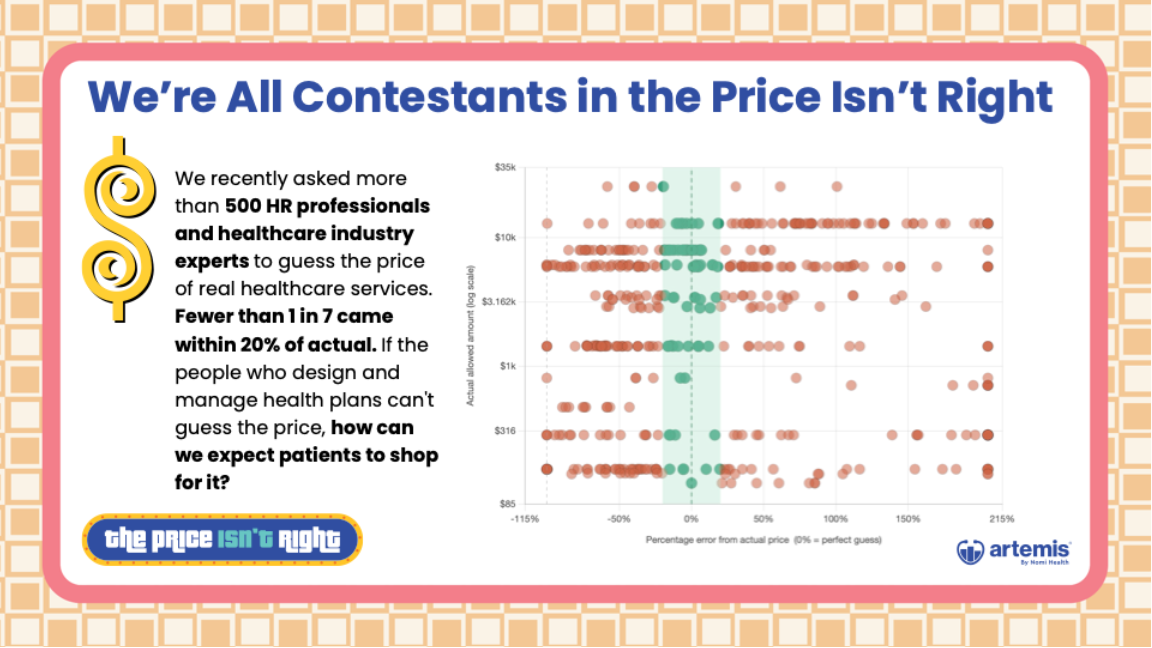
The people getting it wrong aren't confused patients reading their first EOB. They're the ones writing the benefits booklets, designing health plans, negotiating contracts, and processing claims. They're the people posting wonky healthcare data takes on LinkedIn. They include me and many of my colleagues at Nomi Health.
And, for the record, they also include AI.
Not surprisingly, many of our contestants turned to Claude and ChatGPT for help. They were disappointed. This matters because patients are increasingly asking AI what a procedure costs before scheduling it, using it to decode an EOB, treating it as a knowledgeable shortcut through a confusing system. AI has ingested more healthcare data than any human expert could read in a lifetime, and it still couldn't reliably predict what a claim would pay. If anything, that makes the problem clearer: this isn't a knowledge gap.
If Prices Are Unknown, Can Patients Really Be Shoppers?
When patients don't shop well for care, the industry's instinct is to blame the shopper. If only they were more health literate. If only they engaged more. If only they used the tools available to them.
But our experiment points somewhere else. The people guessing wrong weren't disengaged or healthcare illiterate. They were the experts. And even the AI. If the people who design, price, and administer health plans can't guess what a routine claim actually costs, and neither can the AI trained on millions of them, what exactly are we asking patients to do when we tell them to shop for care?
That question has a real answer, and it's embedded in Nomi's products and solutions. We know patients avoid care when the price is a mystery. Give them a predictable price, something as simple as a fixed copay, and their behavior changes. They act like any regular consumer would, making real decisions based on real prices.